Citation cleanup means finding every online listing of your business and fixing wrong names, addresses, phone numbers and duplicates. It matters more in 2026 because AI tools pull business details from those listings. In SOCi’s 2026 study, ChatGPT and Perplexity got business info right only about 68% of the time. Below is the 10-step checklist I use for clients, plus the tools, timelines and mistakes to avoid.
KEY TAKEAWAYS
- Start with one master NAP sheet, then fix Google, Bing and Apple before anything else.
- Fix the data aggregators next. They feed hundreds of smaller sites, so one fix spreads.
- Business info on ChatGPT and Perplexity was only about 68% accurate, versus 100% on Gemini (SOCi via Search Engine Land, 2026).
- Wrong business info would stop 62% of consumers from using a business (BrightLocal, 2023).
- Recheck your top listings every quarter, because data gets overwritten.
What is citation cleanup?
Citation cleanup is the process of finding and fixing incorrect, outdated or duplicate listings of your business across the web.
A citation is any online mention of your business name, address and phone number (NAP). There are two kinds:
- Structured citations are business listings, like Google Business Profile, Yelp, Bing Places and industry directories.
- Unstructured citations are mentions in articles, blogs, news sites and association pages.
Cleanup focuses mainly on structured citations, because they’re the ones search engines, maps apps and AI tools read as business data. A citation audit finds the problems. Cleanup fixes them.
Why does citation cleanup matter in 2026?
Wrong listings cost you customers, and AI tools now repeat whatever your listings say.
- Customers walk away. Incorrect business information is enough to stop 62% of consumers from using a business (BrightLocal, 2023).
- AI tools get it wrong. SOCi studied about 350,000 locations across 2,751 brands. Business info was 68.3% accurate on ChatGPT, 68.0% on Perplexity and 100% on Gemini, which is grounded in Google Maps (SOCi via Search Engine Land).
- Listings feed AI answers. Yext found 42% of AI citations for local businesses come from listings, and ChatGPT leans on third-party listings more than other tools (Yext, 2025).
- Local SEO experts agree. In Whitespark’s 2026 Local Search Ranking Factors, 3 of the top 5 AI search visibility factors were citation factors. Report author Darren Shaw put it simply: in AI SEO, citations are “the new link.”
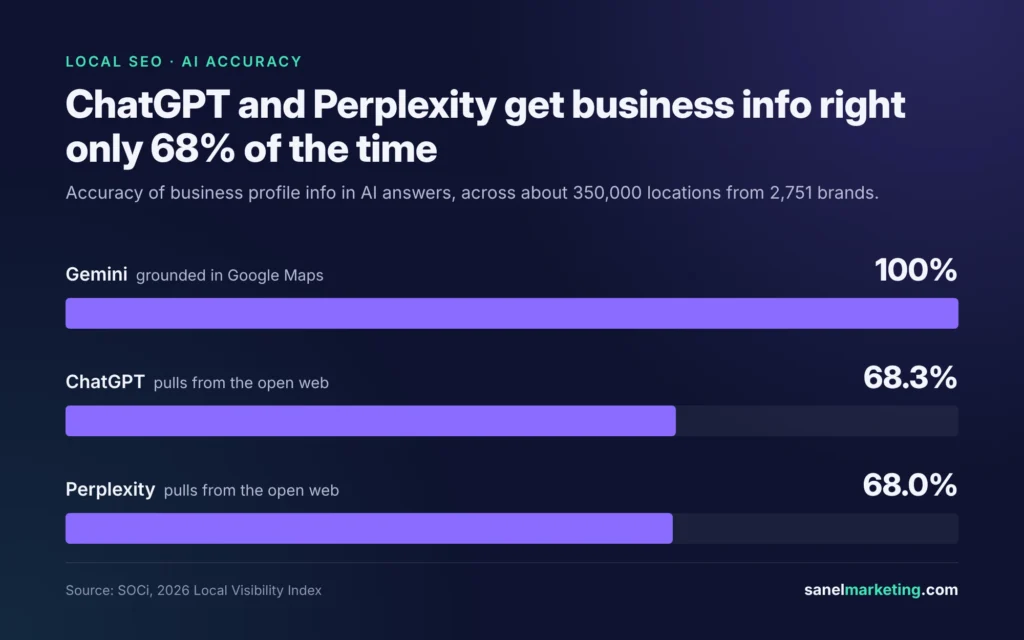
Gemini gets it right because it reads Google Maps directly. ChatGPT and Perplexity piece your details together from the open web, so every wrong listing is a chance for a wrong answer.
What is NAP consistency?
NAP consistency means your business name, address and phone number appear the same way everywhere online.
Google’s own Business Profile guidelines set the baseline that every other listing should copy:
- Name: Use your real-world business name. Don’t add taglines or locations that aren’t part of the real name.
- Address: Use a real location. P.O. boxes and mailboxes at remote locations aren’t allowed. Service-area businesses should hide their address.
- Phone: Use a local number under your direct control, not a number that redirects to a landing page.
- One profile per location: Google allows only one profile per business or location.
Small formatting differences, like “Street” versus “St.,” usually aren’t a problem. Different phone numbers, old addresses and old business names are. Pick one format and use it everywhere.
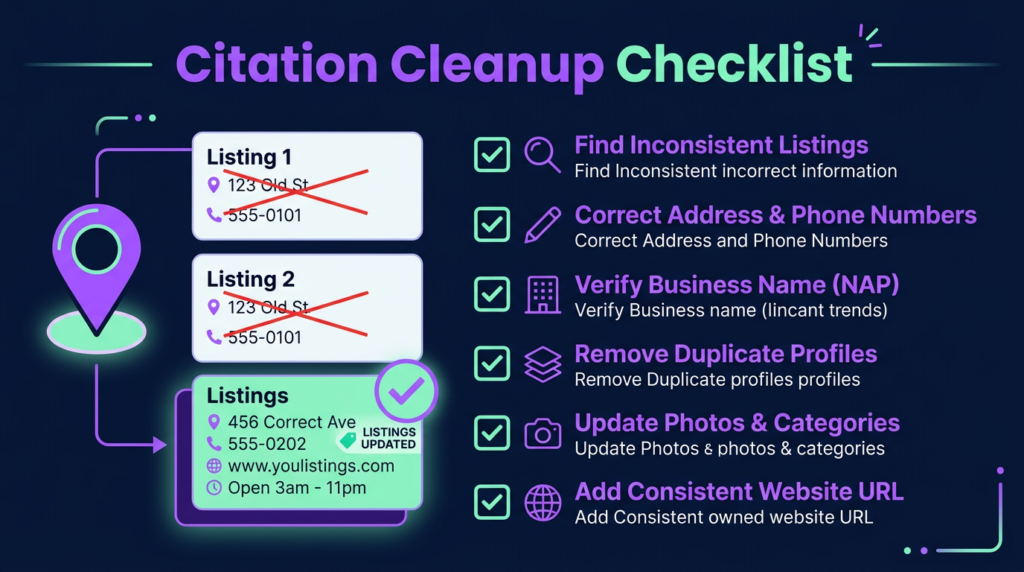
What's the full citation cleanup checklist?
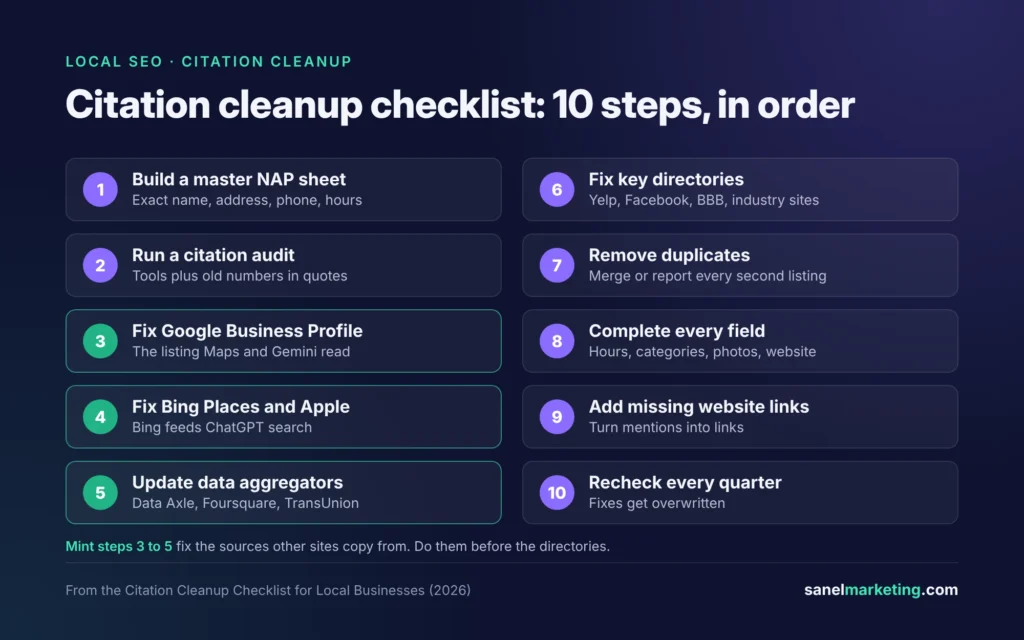
Work through these 10 steps in order. Each one makes the next one faster.
1. Build a master NAP sheet
Write down the exact business info every listing should show, and copy from it every time.
Include the business name, address, phone, website, hours, categories, a short and long description, and your logo and photos. I keep one reference doc per client and paste fields from it verbatim. For one agency client, the first rule in that doc is to use the full brand name every time, never the initials.
Also list every old name, address and phone number. Those are what you’re hunting for in the audit.
2. Run a citation audit
Find every listing of your business, and flag anything that doesn’t match your master sheet.
- Use a citation tool (see the tools table below) to scan the main directories at once.
- Search Google for your old phone numbers and old addresses in quotes. This catches listings the tools miss.
- Log every listing in a sheet: site, URL, what’s wrong, login status and date fixed.
3. Fix your Google Business Profile first
Google Business Profile is the listing Google Maps and Gemini read directly, so get it right before anything else.
Check the name, address, phone, website, hours and categories against your master sheet and Google’s guidelines. If you moved, edit the address on your existing profile. Google says not to create a new profile when you move (Google).
4. Fix Bing Places and Apple Business Connect
Claim and update your listings on Bing Places and Apple Business Connect next.
Bing matters more than ever, because ChatGPT search leans on Bing results. LinksThatRank reports 87% of ChatGPT citations come from Bing’s top 20 results (LinksThatRank). Apple Business Connect controls what shows in Apple Maps and Siri.
5. Update the data aggregators
Submit your correct info to the main US data aggregators, because they feed hundreds of smaller sites.
The main ones are Data Axle, Foursquare and TransUnion’s Digital Business Profile (formerly Neustar Localeze) (BrightLocal). Fixing them first means fewer wrong listings come back after you clean them up by hand.
6. Fix the key directories
Update the sites people and AI tools actually read: Yelp, Facebook, Yellow Pages, BBB and the top directories in your industry.
Claim each listing where you can, so you control future edits. Prioritize sites that rank on page one for your business name, then the main directories for your industry, like Avvo for lawyers or Healthgrades for doctors.
7. Find and remove duplicate listings
Merge or remove any second listing for the same business at the same location.
Duplicates split your reviews and confuse search engines. Google only allows one profile per business, and profiles it marks as duplicates won’t show on Search or Maps (Google). The section below covers how to remove them on Google and Yelp.
8. Fill out every field
Complete every field on your main listings, not just name, address and phone.
Add hours, categories, services, descriptions, photos and your website. Whitespark’s 2026 report recommends getting listed on all prominent industry directories and filling out every listing field (Whitespark). Complete listings give AI tools more accurate details to work with.
9. Add your website link where it’s missing
Turn citations that don’t link to your website into ones that do.
Many directories let you add a website URL, but older or auto-created listings often leave it blank. Add it wherever the site allows. For unstructured mentions, like a local news article or a “best of” list that names you without a link, send a short, polite email asking the writer to add one. For more on earning mentions, see HARO in 2026: how to earn links from journalist requests.
10. Recheck every quarter
Rerun your audit every three months, because aggregators and users can overwrite your fixes.
Check your top 10 listings and your Google Business Profile at least quarterly. Recheck right away after any move, phone change or rebrand.
How do I remove duplicate business listings?
Report the duplicate on the platform, ask for a merge if both listings are the same business at the same location, and contact support if nothing happens.
On Google:
- If you created a duplicate by mistake, remove it from your account. Google warns this removes all its content and managers, so pick the right one (Google).
- If the duplicate is on Google Maps, report it with “Suggest an edit” to request a merge. All merge requests are reviewed.
- If you haven’t heard back within 72 hours, contact Google Business Profile support (Google).
On Yelp:
- Yelp doesn’t delete duplicates. It merges them, and photos and reviews from both listings are combined (Yext).
- Claim your main page, then contact Yelp support through your Yelp for Business account to request the merge.
Can duplicate Yelp listings affect SEO? Yes, indirectly. Duplicates split your reviews and can show customers the wrong address or phone number. They also give AI tools conflicting data to choose from.
What tools help with citation cleanup?
A citation tool finds most of the problems fast. A manual Google search catches the rest.
Tool | Best for |
Finding and tracking citations for single and multi-location businesses | |
Citation Finder, plus a done-for-you cleanup service | |
Ongoing listing management and duplicate detection | |
Pushing data to directories if you already use Semrush | |
Large multi-location brands that need central control | |
Google search | Free. Search old phone numbers and addresses in quotes |
Subscription tools can push updates to many sites at once. But some listings revert when a subscription ends, so check what you keep before you sign up.
How long does citation cleanup take?
Expect a few hours to audit and a few weeks to months for every fix to show up.
Changes on Google, Bing and Apple often show within days once a listing is claimed. Smaller directories fed by aggregators can take longer. Recheck your sheet four to six weeks after your fixes and resubmit anything that hasn’t changed.
Should I do citation cleanup myself or hire a service?
Do it yourself if you have one location and under 50 listings. Hire a citation cleanup service if you have many locations, many old addresses or listings you can’t access.
Do it yourself | Hire a service | |
Best for | 1 location, few changes | Many locations, moves or rebrands |
Cost | Your time, plus optional tool fees | One-time or monthly fee |
Speed | Slower, one site at a time | Faster, with existing directory access |
Risk | Missing listings you didn’t know about | Listings that revert if a subscription ends |
Ask any provider whether you’ll own the listings afterward, and for a before-and-after report.
How do I know if AI tools have my info right?
Ask them, the way a customer would, and track what changes after your cleanup.
- Ask ChatGPT, Gemini, Perplexity and Google AI Mode questions like “What are the hours and phone number of [business] in [city]?”
- Note any wrong detail, and trace it back to the listing it likely came from.
- Watch branded searches and AI referral traffic in Google Search Console and GA4. AI-driven visits often show up as organic or direct traffic (Neil Patel).
- Ask every new lead how they found you, and include “ChatGPT or another AI tool” as an option.
For more on where AI gets local business data, see the AI search statistics for local businesses.
What citation cleanup mistakes should I avoid?
Most cleanup problems come from skipping the source data or creating new listings instead of fixing old ones.
- Fixing small directories before Google, Bing, Apple and the aggregators. The wrong data comes back.
- Creating a new listing when you move. Edit the existing one instead.
- Using different name versions. “Smith Plumbing” and “Smith Plumbing & Heating LLC” look like two businesses.
- Using a call-tracking number on some listings and not others. Keep your main local number as the primary on every citation.
- Never checking again. Data drifts, so recheck quarterly.
Frequently asked questions
What is the difference between citation building and citation cleanup?
Citation building creates new listings on sites where your business isn’t listed yet. Citation cleanup fixes the listings that already exist. Do cleanup first, so you don’t copy wrong data onto new sites.
Do citations still matter for local SEO in 2026?
Yes. Whitespark’s 2026 Local Search Ranking Factors found 3 of the top 5 AI search visibility factors are citation factors. Consistent citations on Google, Bing and Apple also still count toward map pack rankings.
How often should I audit my citations?
Every quarter, and right away after a move, phone change or rebrand. Aggregators and user edits can overwrite your fixes.
What is a good NAP consistency tool?
BrightLocal Citation Tracker, Whitespark Citation Finder, Moz Local and Semrush Listing Management all check NAP consistency. For a free check, search your old phone number and address in quotes on Google.
Does my NAP need to match exactly?
Close is fine for formatting, like “Street” versus “St.” The name, phone number and address itself should be the same everywhere.
Can duplicate Yelp listings affect SEO?
Yes, indirectly. They split your reviews and can show the wrong details to customers and AI tools. Yelp merges duplicates instead of deleting them.