Yes, HARO still works for link building in 2026. Featured.com bought HARO in April 2025 and relaunched it as a free email service. Journalists post requests, you answer the ones you’re qualified for, and if they use your quote you get a mention and often a link. What wins now is speed, real expertise and a pitch written by a human. Below is how HARO works today, how I write pitches, the best alternatives, and why these mentions also help you get cited by AI tools.
KEY TAKEAWAYS
- HARO is free for sources and sends up to three emails of journalist requests each weekday (HARO).
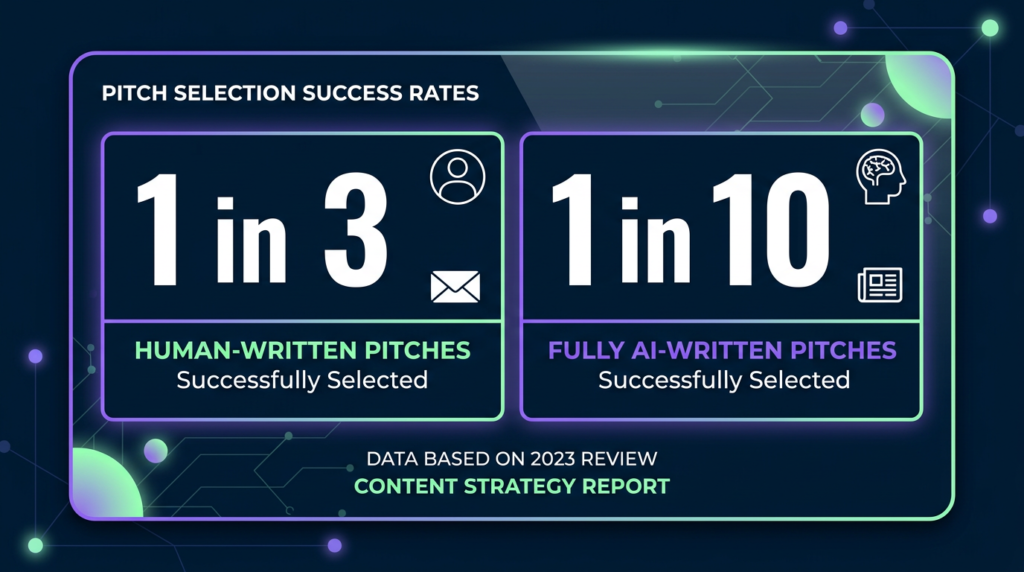
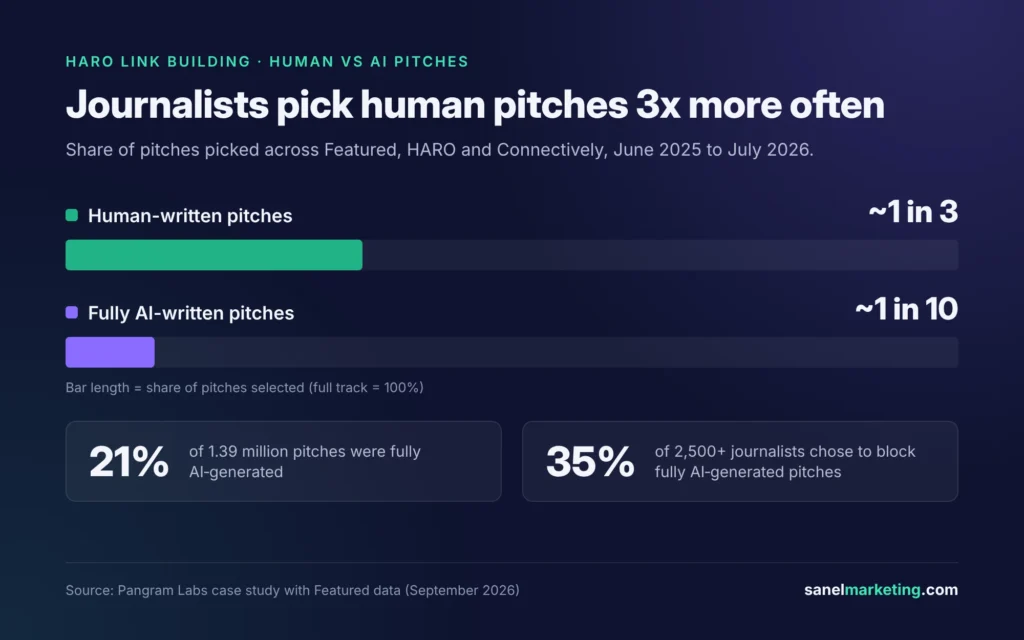
- Human-written pitches were picked about 1 in 3 times, versus about 1 in 10 for fully AI-written ones (Pangram Labs, 2026).
- In an Ahrefs test, only 4% of 47 pitches understood what the journalist actually needed (Ahrefs).
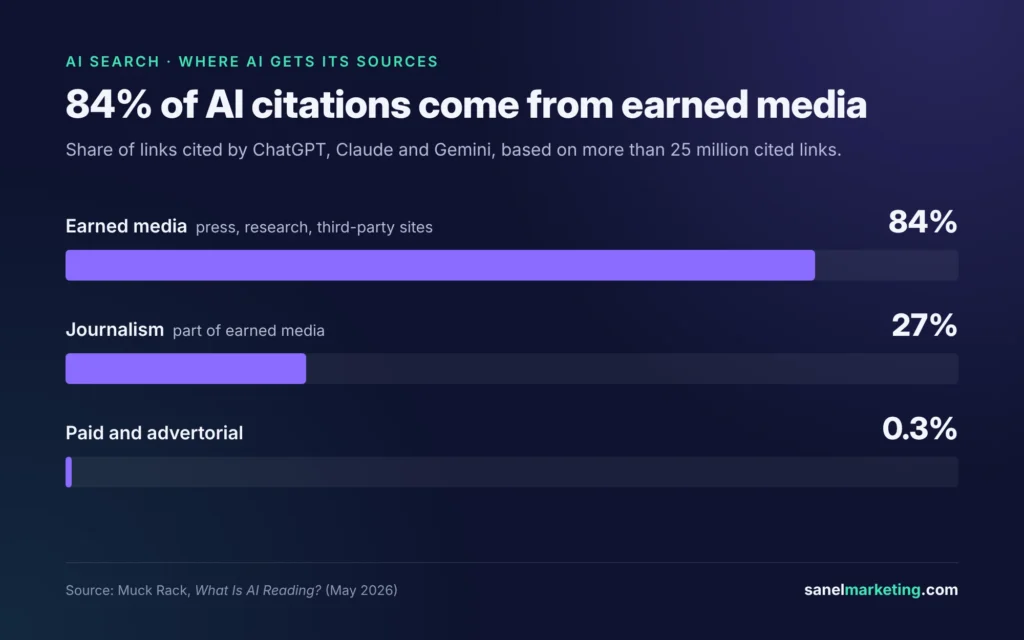
- 84% of AI citations come from earned media, and 27% from journalism (Muck Rack, May 2026).
- Brand mentions correlate 3x more strongly with AI Overview visibility than backlinks do (Ahrefs).
What is HARO?
HARO (Help a Reporter Out) is a free email service that sends journalist requests to expert sources.
Journalists submit a query with the expert they need, their question and a deadline. Sources get the queries by email and pitch an answer. If a journalist uses your answer, you’re usually credited, often with a link to your website (HARO).
HARO has more than 800,000 registered sources and more than 75,000 journalists and bloggers, according to its own site.
Is HARO still active in 2026?
Yes. HARO shut down in 2024, then Featured.com bought it and brought it back in 2025.
Here’s the short timeline, from HARO’s About page:
- 2008: Peter Shankman founds HARO.
- 2010 and 2014: Vocus buys it, then it becomes part of Cision.
- 2024: Cision renames it Connectively, then shuts it down in December.
- April 2025: Featured.com acquires HARO and relaunches it (Featured via PR Newswire).
- May 2026: Featured also revives Connectively as a platform version (GlobeNewswire).
Connectively passed 100,000 users in June 2026 (PR Newswire). HARO stays the free email option. Connectively is for people who prefer a dashboard, keyword alerts and tracking.
How does HARO work?
Journalists post requests, HARO emails them to sources, and sources reply by email.
- A journalist submits a query. HARO reviews it first and rejects about a third of requests (HARO).
- You get up to three digest emails each weekday, Monday to Friday.
- You reply to the journalist through a masked email address.
- If the journalist likes your answer, they quote you or contact you for more.
- The article goes live, usually with your name, title, company and often a link.
HARO is funded by newsletter ads, so it’s free for both journalists and sources. It also scores every pitch for AI-generated text, so journalists can filter those out.
Does HARO still work for backlinks?
Yes, if your pitches are fast, relevant and written by you. Most pitches fail on quality, not on the platform.
- Human pitches win. Across Featured, HARO and Connectively, human-written pitches were picked about 1 in 3 times. Fully AI-written pitches were picked about 1 in 10 times (Pangram Labs, based on 1,394,740 pitches from June 2025 to July 2026).
- Most pitches miss the point. When Ahrefs posted its own journalist request, it got 47 replies. 68% were a waste of time, only 36% included data, and just 4% understood what the writer needed (Ahrefs).
- Links aren’t guaranteed. HARO says published sources are “often” credited with a link, not always. Some publishers also add nofollow or sponsored tags to outbound links.
That’s good news for you. If most pitches are generic, a specific, sourced answer stands out quickly.
Why do journalist mentions help you get cited by AI?
AI tools lean heavily on news and other earned media when they cite sources, so a quote in a real article can feed AI answers.
Muck Rack analyzed more than 25 million links cited by ChatGPT, Claude and Gemini (Muck Rack, May 2026):
- 84% of AI citations came from earned media.
- 27% came from journalism, spread across more than 20,000 outlets.
- Paid and advertorial content made up just 0.3%.
- More than half of journalism citations were from articles published in the past 12 months.
Brand mentions matter too, even without a link. Ahrefs studied 75,000 brands and found branded web mentions had the strongest correlation with AI Overview visibility (0.664), versus 0.218 for backlinks (Ahrefs). That’s correlation, not proof. But it’s why I treat every HARO quote as a link and an AI visibility win at the same time.
For the full on-site side, read how to get your business cited in Google AI Overviews.
How do I use HARO for link building?
Sign up as a source, filter the emails, and answer only the queries you can genuinely help with, fast.
- Sign up as a source at helpareporter.com. It’s free.
- Set up email filters. Send HARO emails to their own label. Then flag the keywords that match your expertise, like “SEO,” “small business” or “real estate.”
- Check every digest within an hour or two. Journalists work on tight deadlines, and early replies get read first.
- Pick 2 to 3 queries a day, not 20. Only answer where you have direct experience. HARO’s rule of thumb is to answer requests you’re qualified for.
- Write the pitch yourself. Lead with the answer, add one piece of proof, and keep it short. Use the template below.
- Reply fast to follow-ups. Ahrefs’ author found quick follow-up replies raised the chance of being quoted.
- Log every pitch. Track the date, outlet, query, status and live URL in a sheet.
- Reuse each win. Add an “As featured in” section, update your author bio, and share the article on LinkedIn.
A real HARO win: what it looks like
Here’s one I landed for a client, Solo Media Group, a Shopify agency in New York.
- Outlet: ContentForce, in “Ecommerce SEO Tips: A Practical Guide From 6 Practitioners,” published November 13, 2026.
- The request: Practitioners’ single best ecommerce SEO tip.
- What we sent: One specific tip from real client audits. Check that key product details, like sizing and specs, are in the page source and not loaded by an app after the page loads. We included a 10-second test (view source, search for a phrase) and the fix (store the content in Shopify metafields).
- The result: A quote credited to “Johnathan Solorzano, Founder at Solo Media Group,” with a link to the agency’s homepage.
Why it worked: it answered the exact question, it came from first-hand work, and readers could test it right away. That’s Helpful, Authentic, Relevant and On time in practice.
The same approach landed more quotes for the same client in Deel Works (November 2026), Eastern Standard (September 2026) and Marker.io (October 2026). The Marker.io quote has no link, but it’s still a brand mention on a trusted site.
How do I write a HARO pitch that gets picked?
Answer the journalist’s exact question in the first sentence, then prove it with something specific.
Brett Farmiloe, Featured’s founder, sums it up as HARO itself: be Helpful, Authentic, Relevant and On time (Ahrefs).
- Lead with a quotable line. Write one sentence the journalist could paste straight into the article.
- Add proof. Use a number, a client result or a step you’ve seen work.
- Show credentials early. One line with your title, years of experience or license.
- Keep it under 200 words. Journalists skim dozens of replies.
- Skip the basics. Don’t explain what the journalist already knows.
- Include a short bio and links. Add your website, LinkedIn and a headshot link.
HARO pitch template
Subject: [Query headline], [Your title] at [Company]
Hi [Name],
[One-sentence direct answer to their question.]
[Two or three sentences of proof: a number, an example or a step you’ve seen work.]
[Optional: one short, quotable line.]
About me: [Name], [title] at [Company]. [One credibility line: years, clients or license.] [Website] | [LinkedIn] | [Headshot link]
Happy to answer follow-up questions today.
[Name]
Should I use AI to write HARO pitches?
No. Use AI to research or check your grammar, but write the answer yourself. Journalists are filtering out AI pitches.
From Pangram Labs’ year of data on Featured, HARO and Connectively (Pangram, September 2026):
- About 21% of 1,394,740 pitches were fully AI-generated.
- 35% of more than 2,500 journalists chose to block fully AI-generated pitches, even though that filter is off by default.
- Human-written pitches were picked about 3x as often as fully AI-written ones.
- Banned accounts were about 3.6x more likely to have sent a fully AI-generated pitch.
HARO doesn’t ban accounts just for AI pitches, but they can trigger internal monitoring. The bigger cost is that your pitch simply doesn’t get picked.
What are the best HARO alternatives in 2026?
The strongest alternatives are Connectively, Featured, Qwoted, Source of Sources and MentionMatch. I’d use HARO plus one or two of them.
Platform | Best for | Price for sources |
Free journalist requests by email, all beats | Free | |
HARO-style requests inside a platform, with alerts | Free (3 answers a month), paid from $19/month | |
An AI-guided PR workflow built on HARO, Connectively and partner opportunities | Free plan, paid from $39/month | |
Higher-tier media and PR teams | Free (2 pitches a month), Pro $149.99/month | |
The closest thing to the original HARO, run by its founder | Free | |
MentionMatch (formerly Help a B2B Writer) | Quotes in B2B and marketing content | Free |
Prices checked November 2026 on each platform’s site. Connectively prices are from HARO’s comparison page.
A few notes:
- Connectively and Featured are owned by the same company as HARO. HARO queries also appear in Connectively.
- Source of Sources was launched in 2024 by Peter Shankman, HARO’s original founder. It’s independent of Featured and sends up to three emails a day (HARO).
- MentionMatch is Superpath’s new name for Help a B2B Writer. It sends you only the requests that match the fields you pick.
- #journorequest on X is free too. Journalists post requests publicly, so watch the hashtag for your niche.
If you’d rather hand off the pitching, see the 9 questions to ask before hiring a white-label link building partner.
What mistakes get HARO pitches ignored?
Most rejected pitches are late, off-topic, generic or obviously AI-written.
- Pitching off-topic. It wastes the journalist’s time, and HARO uses community reporting and lifetime bans for policy violations.
- Replying late. A great answer after the deadline is worth nothing.
- Writing an essay. Long pitches get skimmed and skipped.
- Making claims without proof. “Trust me” with no example or number rarely gets quoted.
- Asking for a link up front. Earn the quote first. Credit is the journalist’s call.
- Sending AI copy. It’s flagged, and journalists can block it.
How do I track HARO results?
Track three things: placements, links and whether AI tools start mentioning you.
- Placements: Set up a Google Alert for your name and brand, since journalists don’t always tell you when an article goes live.
- Links: Check new backlinks in Semrush, Ahrefs or Google Search Console every few weeks.
- AI mentions: Ask ChatGPT, Gemini, Perplexity and Google AI Mode the questions your buyers ask. Note whether your brand shows up.
- Leads: Ask every new lead how they heard about you, and include “an article” and “an AI tool” as options.
The AI search statistics for local businesses post has more data on how AI tools pick sources.
Frequently asked questions
Is HARO free?
Yes. HARO is free for sources and journalists, and it’s funded by newsletter advertising. Paid options exist on related platforms like Connectively and Featured, but HARO itself has no paid tier.
Is HARO still around in 2026?
Yes. Cision shut HARO down in December 2024, and Featured.com bought it and relaunched it in April 2025. It still sends up to three emails of journalist requests each weekday.
Are HARO backlinks dofollow?
Sometimes. Each publisher decides whether to link and which link attributes to use. Even a nofollow link or an unlinked mention can still build trust and AI visibility.
Is HARO link building white hat?
Yes. You earn the mention by giving a journalist useful expertise, and you don’t pay for the link. That’s different from buying links, which goes against Google’s spam policies.
How long does it take to get results from HARO?
It varies. Some quotes go live within days and some take weeks. Answering 2 to 3 good queries a day usually beats answering many weak ones.
What's the difference between HARO and Connectively?
HARO is the free email version. Connectively shows HARO queries inside a platform, adds keyword alerts and tracking, and has a free plan with 3 answers a month.