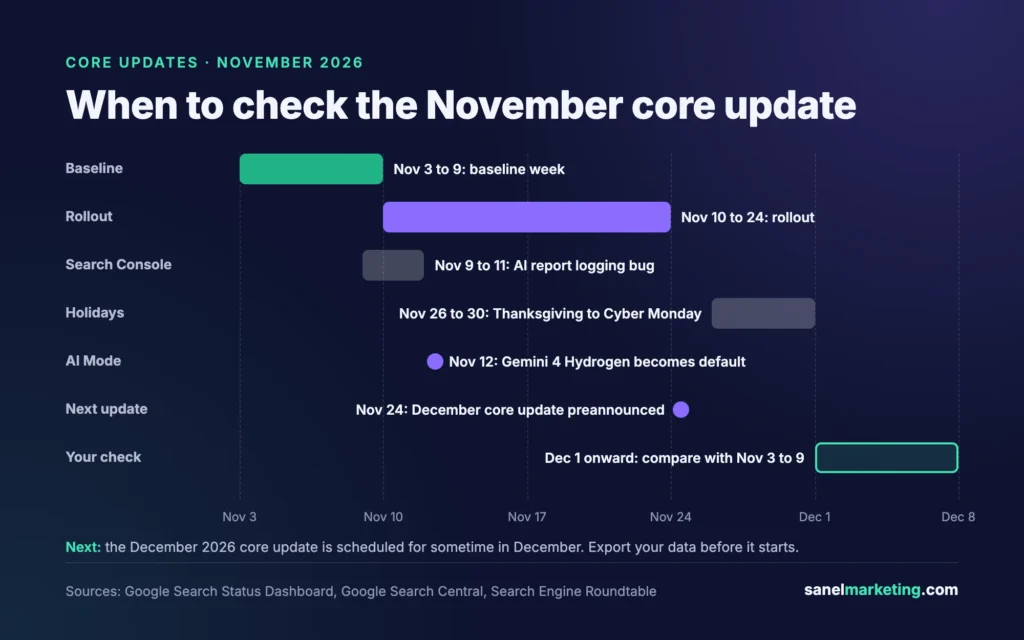
Google’s November 2026 core update ran from November 10 to November 24. Google says to wait at least a full week after a core update finishes before judging the impact, so agencies shouldn’t call wins or losses before December 1. This one is harder to read than most: the week after it falls on Thanksgiving and Black Friday, and Google has already preannounced a December core update. Here’s the checklist I’m using for client sites.
KEY TAKEAWAYS
- The rollout started November 10 and finished November 24, after 13 days and 20 hours (Google Search Status Dashboard).
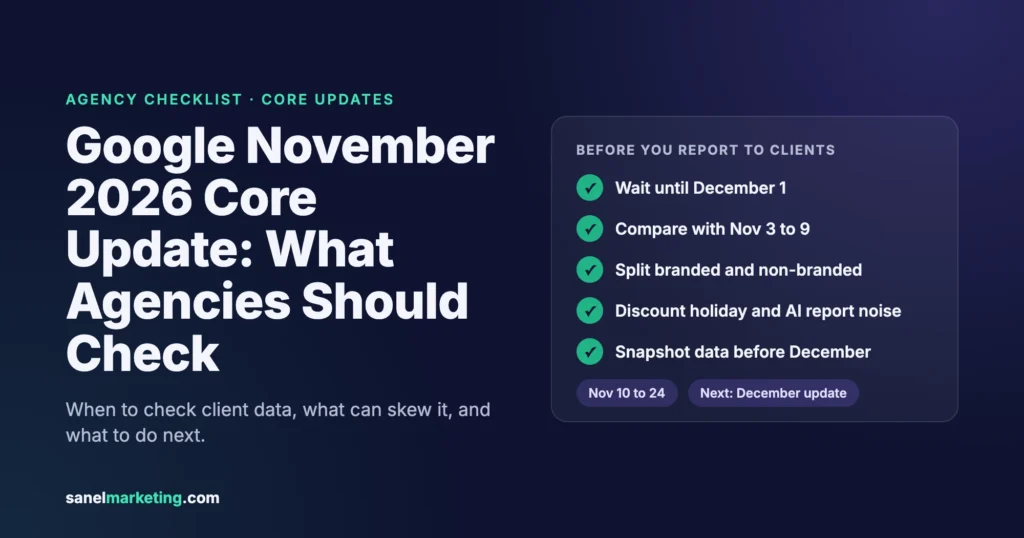
- Don’t judge the impact before December 1. Then compare a full week after the update with November 3 to 9.
- Holiday traffic, a Search Console AI report bug on November 9 to 11 and the new Gemini model in AI Mode can all look like core update losses.
- Google has preannounced a December 2026 core update focused on longer, more complex questions and personalized results.
- If a client lost traffic, don’t rush changes before December. Save a clean snapshot of the data now.
When did the Google November 2026 core update start and finish?
It started on November 10, 2026, and finished on November 24, 2026, taking 13 days and 20 hours.
| Detail | November 2026 core update |
|---|---|
| Started | November 10, 2026, 10:06 a.m. PT |
| Finished | November 24, 2026, just after 9 a.m. ET |
| Rollout time | 13 days, 20 hours |
| Scope | Global, all languages |
| Core updates this year | Third, after March and May 2026 |
Google called it “a regular update designed to better surface relevant, satisfying content for searchers from all types of sites” (Search Engine Roundtable). It didn’t say what changed. Industry tools showed the most volatility around November 14, a few days after launch.
When should agencies check the impact?
From December 1 at the earliest. Google recommends waiting at least a full week after a core update completes before analyzing Search Console data (Google Search Central).
Then compare a full week after the update with the week before it started. For this update, that baseline week is November 3 to 9.
“Don’t panic in the first week of a core update. Wait until it finishes rolling out, compare the week after to the week before, and only then decide what’s a real drop.”
Sanel “Nel” Espina, SEO Specialist
What can make the November 2026 core update look worse than it is?
Four things happened around this update that can look like ranking losses in client reports.
- Holiday traffic. Thanksgiving was November 26, Black Friday November 27 and Cyber Monday November 30. That week is a bad match for a normal week in early November. Compare it with the same week last year too.
- A Search Console bug. Google confirmed a logging error lowered impressions in the Generative AI performance report from November 9 to 11. It affected data only, not rankings (Search Engine Roundtable).
- A new AI model in Search. Google made Gemini 4 Hydrogen the default in AI Mode on November 12, calling it the “biggest model upgrade to Search yet” (Search Engine Land). Changes in AI Overviews and AI Mode traffic may come from that, not the core update.
- Unconfirmed volatility before launch. Rankings moved on November 8 and 9, before Google announced the update. Check whether a client’s drop started before November 10.
What should agencies check first?
Start with dates and data quality, then move to pages, queries and revenue.
- Annotate the dates. Mark November 10, November 24 and December 1 in every client report and GA4 property.
- Save a snapshot now. Export Search Console data for November 3 to 9 and the weeks since. You’ll need a clean comparison before the December update muddies it.
- Split by search type. Check Web, Images, Video and News separately, as Google recommends, so you can see where a drop actually happened.
- Split branded and non-branded queries. Branded drops usually point to demand or seasonality. Non-branded drops are more likely to be the update. Search Console’s Search Analytics API now supports branded query filters.
- Check your top pages and queries. Google says small position drops don’t need drastic action, but a big drop, like position 4 to 29, needs a closer look.
- Look at AI visibility separately. Ignore AI report impressions for November 9 to 11. Check whether clients still appear in AI Overviews and AI Mode for their main questions.
- Check leads and revenue, not just clicks. A traffic dip on informational pages may not touch conversions at all.
- Rule out other causes. Check for manual actions, security issues, indexing errors and site changes made in November.
Is it a real drop or just noise?
A drop that lasts, covers non-branded queries and shows up across many pages is usually real. A short dip that matches holidays, a single page or a known data bug is usually noise.
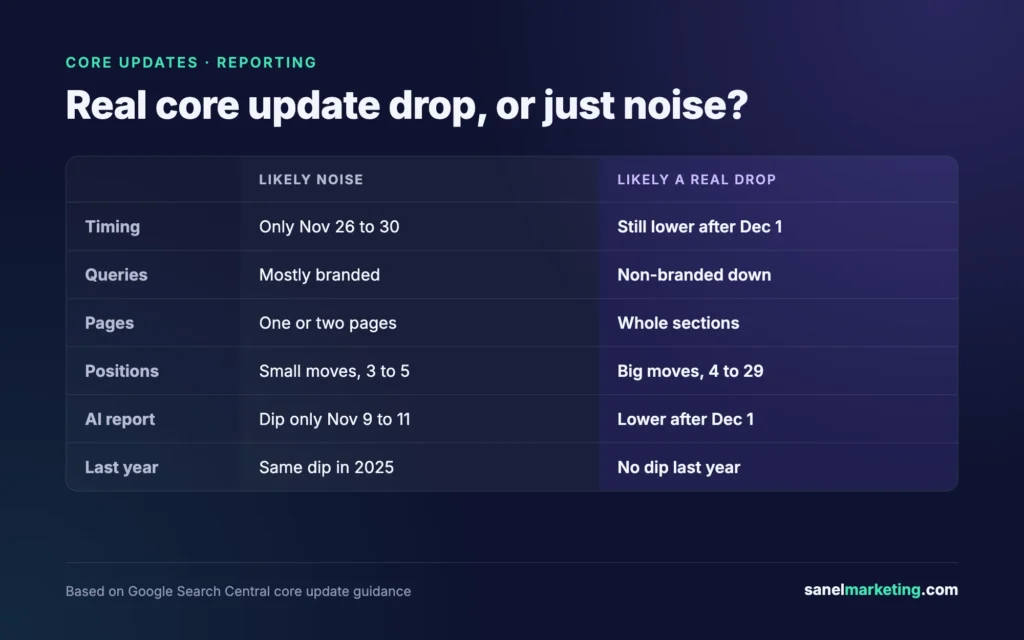
| Signal | Likely noise | Likely a real drop |
|---|---|---|
| Timing | Only during November 26 to 30 | Still lower after December 1 |
| Queries | Mostly branded | Non-branded queries down |
| Pages | One or two pages | Whole sections or templates |
| Positions | Small moves, like 3 to 5 | Big moves, like 4 to 29 |
| AI report | Dip only on November 9 to 11 | Lower AI impressions after December 1 |
| Last year | Same dip in late November 2025 | No dip last year |
What should agencies do if a client lost traffic?
Hold off on big changes until after December 1, then fix the pages that lost the most, starting with the ones that make money.
Google’s guidance is clear: avoid quick fixes, focus on lasting improvements, and treat deleting content as a last resort (Google Search Central). Some changes show results in days, but Google says it can take several months for its systems to confirm a site has improved.
- Review the pages that lost the most. Compare them with the pages that replaced them. Ask what the new top results answer better.
- Improve, don’t rewrite for keywords. Add first-hand experience, clearer answers and fresher data.
- Build trust from other sites. Brand mentions and links from real publications still help. See how to earn links from journalist requests.
- Don’t stop working. Google also releases smaller core updates it doesn’t announce, so improvements can count before the next big one.
“Most businesses only fix their own website. But AI tools trust what other sites say about you more than what you say about yourself, so the fastest wins usually come from mentions on third-party sites.”
Sanel “Nel” Espina, SEO Specialist
How should agencies prepare for the December 2026 core update?
Lock in your November data now, then prepare clients for a second round of movement in December.
On November 24, Google preannounced a December 2026 core update, the first time it has announced a core update in advance. Google said it “focuses on multiple improvements to how our systems understand and rank relevant content (including for longer and more complex questions), as well as improving personalized results for people who have personalization turned on” (Google Search Status Dashboard).
What that means for agency work:
- Your clean window is short. If the December update starts early in the month, there may only be a few days of data between the two updates. Export everything now.
- Long, specific questions matter more. Make sure client pages answer detailed questions directly, not just short keywords. Here’s how to structure pages to get cited in AI answers.
- Rank tracking gets less reliable. Personalized results mean two people can see different rankings. Lean on Search Console, leads and revenue, not just rank trackers.
How should agencies explain the update to clients?
Tell clients early, keep it short, and give them a date for the real answer.
Here’s a message you can adapt:
Google finished a core update on November 24, and another one is due in December. Rankings often move for a couple of weeks during these updates, and Thanksgiving week will also skew traffic. We’re tracking your data now and will share a clear before-and-after on [date]. Until then, we’re not making reactive changes.
Clients mostly want to know you’re watching. A dated follow-up does more than a long explanation.
Frequently asked questions
When did the Google November 2026 core update finish?
It finished on November 24, 2026, after starting on November 10. The rollout took 13 days and 20 hours.
How long should I wait to check core update impact?
At least a full week after the update finishes, according to Google. For the November 2026 core update, that means December 1 at the earliest.
Which dates should I compare in Search Console?
Compare a full week after the update finished with November 3 to 9, the week before the rollout started. Also compare with the same week last year, because of Thanksgiving and Black Friday.
Why did my AI Overview impressions drop on November 9 to 11?
Google confirmed a logging error in the Search Console Generative AI performance report for those dates. It affected data only, not your actual visibility.
What is the December 2026 core update?
It’s Google’s next core update, preannounced on November 24 and scheduled for December 2026. Google says it focuses on longer and more complex questions and on personalized results.
Can a site recover from a core update?
Yes, but it takes time. Google says improvements can take several months to be recognized, and some sites recover with the next core update or smaller unannounced updates.